Is Owner Building Worth It? Why We'd Do It Again
We wanted a house that looked custom without paying custom prices. Owner building got us there — here's what made it worth the work, and what it cost us.
By Mitch · Updated 30 September 2026 · 6 min read
Yes, it was worth it — and we'd do it again. We wanted a house that looked like it had been designed for us rather than picked off a display village, and we didn't want to pay custom-builder money for it. Owner building was the only route we found that gave us both, and the finished house is exactly what we pictured.
This is a personal account, not advice. Owner-builder rules, thresholds and insurance requirements differ in every state and territory — our guide to owner builder permits sets out what each one requires, and your state's regulator is the authority on your build.
Why we didn't go with a volume builder
We looked at a lot of display homes, and after enough of them they started to blur together. Same façades, same open-plan rectangle, same tiles, same tap in three different finishes.
None of it was badly built. It just all looked like the same house wearing different clothes, and a lot of it felt cheap once you looked past the styling in the display — the bits that photograph well are the bits they spend on.
Then you start reading the inclusions list and find that most of what made the display home look good is an upgrade. The price that got you in the door is for a version of the house nobody actually buys.
What we actually wanted
A house with some character. Rooms in the places that suited our block's orientation rather than where the standard plan put them. Materials we'd chosen because we liked them, not because they were in the standard range.
That's a custom home, and custom homes are priced accordingly. A custom builder designs and builds to your brief, and you pay for that in the contract price. We looked at it, and for the house we wanted it wasn't going to work financially.
So we had the problem a lot of people have: we wanted what a custom builder offers at closer to what a volume builder charges. Those are normally two different products at two different prices.
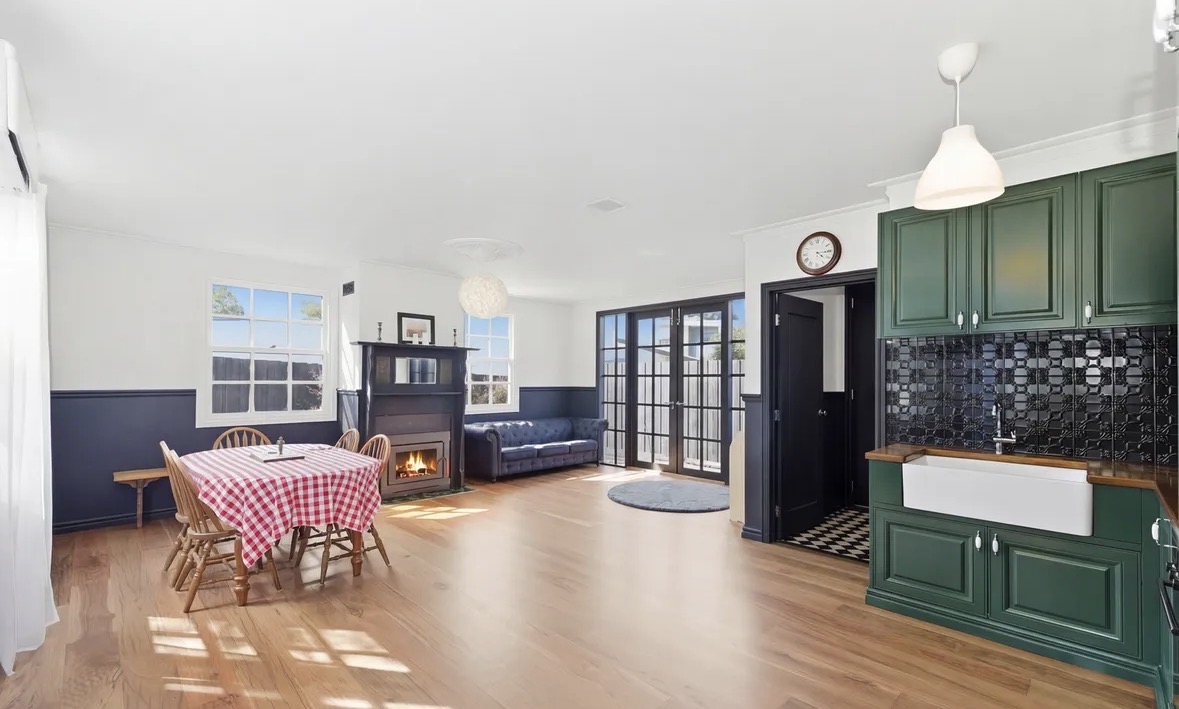
The finished room. Every material in this photo was a decision we made ourselves.
Could we actually do it without experience?
This is the part I assumed would rule us out. I'd never built anything. I don't have a trade. I imagined there'd be some barrier — a qualification, a licence, something that meant it wasn't available to us.
There isn't one. The owner-builder schemes are built around a permit and, in most states, just a short course.
Every state and territory runs its own scheme, with its own threshold, course, waiting period and insurance rules. Check yours before you plan anything around it — the permits guide has each one.
The other thing worth saying plainly: you're not doing the building. Licensed trades still do the trade work, and for plumbing, electrical and gas that's not optional. What you're taking on is the organising.
What was hard about it
I'd be doing you a disservice if I only wrote the good half.
The hardest part wasn't any single decision. It was that there were hundreds of them, they arrived in no particular order, and most of them had a deadline attached that I only found out about when someone rang me.
I didn't know what things should cost, so when a price came back I had nothing to compare it against. I didn't know the sequence, so I learned the order of a build in pieces, usually just in time. And I lost track of who I'd contacted — dozens of trades, replies arriving by text, email and phone call over weeks.
I've written about that side of it properly in our story, because it's the reason this software exists.
None of it was beyond me. It was just relentless, and it ran alongside a job.
What made it worth it
Every choice was ours. Not chosen from three options on an upgrade sheet — actually ours. Where the windows went. What the kitchen was made of. Which direction the living room faced. When you hold every decision, the house ends up being the one you imagined, because nobody else ever got a say in it.
We could spend where it mattered. Nobody was applying a standard allowance to things we cared about. If we wanted to put money into the things people see and touch every day and save it somewhere less visible, we could, and we did.
The satisfaction is real and it lasts. Walking through a house you coordinated into existence is a different feeling from walking through one you bought. Every part of it is a decision you remember making.
Who it suits, and who it doesn't
It suits you if you already know what you want. The control is only worth something if you have a clear picture to apply it to — if you'd be happy with a good standard house, a volume builder will give you one with far less of your life spent on it.
It doesn't suit you if you need certainty about the final number before you start. You're assembling the price as you go, which is exactly why you can control it — and also why you don't know it at the beginning.
And it doesn't suit you if you're doing it purely to save money. Removing the builder's margin is real, but you pay for it in your own time and you carry the risk of your own mistakes. Treat the saving as something you earn by being organised, not as something that arrives with the permit.
Would we do it again?
Yes. Knowing everything it took, yes — because the result is a house that isn't like the ones we walked through in the display village, and we didn't pay custom prices to get it.
The part I'd change is how organised I was. Everything lived in my email. I lost track chasing quotes, I wasn't keeping count of what I'd spent, and the timeline confused me the whole way through. Honestly, it was chaos.
That's what we ended up building SiteForeman for: it reads your plans, prices the build stage by stage from published Australian rates, lays out the timeline, keeps track of the quotes you've sent and follows your budget. Everything I needed at the time and didn't have.
Related reading
Common questions
- Is owner building worth it?
- It depends on what you want out of it. If you want a specific house and don't want to pay custom-builder prices for it, owner building is one of the few ways to get there, because you keep the decisions and the builder's margin. If you mainly want a house with the least possible effort, it isn't — you're taking on months of coordination that a builder would otherwise absorb.
- Can you owner build with no building experience?
- Yes. The owner-builder schemes are built around a permit and, in most states, a short course — not a construction résumé. New South Wales requires a permit above $10,000 and a course above $20,000; Queensland requires a permit above $11,000 and a course. Neither asks whether you've built before. What you actually need is time, attention and the willingness to ask questions.
- What's the difference between an owner builder and a volume builder?
- A volume builder sells you a house from a catalogue of set designs at a set price, and manages the build. As an owner builder you hold the approval yourself and engage each trade directly, which means every design and material decision stays with you. The trade-off is that the coordination, the scheduling and the responsibility are yours too.
- Do you save money owner building?
- You remove the builder's margin, which is real money, but it isn't free. You pay for it in your own time, and in the risk that a mistake or a delay costs more than the margin you saved. Treat any saving as something you have to earn through good organisation rather than something that arrives automatically.
- Do you need to be handy to be an owner builder?
- No, and it's the most common misunderstanding about it. Licensed trades still do the trade work — in most cases you're not touching a tool. The job you're taking on is project management: getting the right people in the right order, making decisions when they're needed, and keeping track of what's been quoted, agreed and paid.
Sources
Regulatory and statistical claims in this article, and where each comes from. Building rules change — confirm anything critical with your own regulator.
- New South Wales requires an owner-builder permit for work over $10,000, an approved owner-builder course for work of $20,000 or more, and a white card — but no prior building experience
Service NSW — Apply for an owner-builder permit · checked 30 September 2026 - Queensland requires an owner-builder permit for work valued over $11,000 and completion of an owner-builder course (or an exemption based on holding a licence or qualification), not prior experience
QBCC — Apply for an owner-builder permit · checked 30 September 2026